Message a Cue agent from your own WhatsApp account by linking Cue CLI as a device, and understand that Cue replies from your number.
Cue OS lets you message a Cue agent from WhatsApp. Cue CLI on your computer links to your own WhatsApp account as a linked device, the same way WhatsApp Web does. There is no separate bot: Cue's replies are sent from your own number. Only the people you add as owners can run the agent.
What you can do
- Message the agent in your Message yourself chat and get the reply in the same chat.
- Decide who may run the agent: only owners you add on your computer.
- Unlink Cue from your account when you are done.
On the web
There is no WhatsApp setup screen in Cue OS on the web, and WhatsApp is not listed in Settings → Connectors. Set it up with Cue CLI as shown below.
On iPhone and Android
The iPhone and Android apps are coming; store review is pending. You can use Cue OS in your phone browser now. You scan the link code with WhatsApp on your phone, and once linked you can message the agent from WhatsApp there.
With Cue CLI
WhatsApp runs in Cue CLI's background worker on the computer where your agent lives. These steps use the default agent, main.
-
Link your account. A QR code appears in the terminal:
cue --agent main whatsapp loginIn WhatsApp on your phone, open Linked devices (in Settings on iPhone, or the menu on Android), choose Link a device, and scan the code. If the code expires, run the command again.
The first time you link, Cue turns WhatsApp on, accepts direct messages only from your own number, keeps groups off, and would answer in groups only when mentioned.
-
Restart the background worker so it picks up the link, then check the connection. The WhatsApp status shows whether the account is linked:
cue client restart --agent main --json
cue --agent main whatsapp status --json
cue --agent main channel status --provider whatsapp --json
If the status says the channel runtime worker is unavailable, start it with
cue client start --agent main. -
Open your Message yourself chat in WhatsApp and send a message. Until you are an owner, Cue replies "Access denied. Your whatsapp user ID is your ID" and shows the command to run. Copy the ID from that reply, run the command on your computer, then send your message again:
cue --agent main channel owner add --provider whatsapp <your-whatsapp-id>Cue's answer appears in the same chat, sent from your own account.
-
To unlink, log out and turn WhatsApp off, then restart the worker. This deletes the link on your computer; also remove the device under Linked devices in WhatsApp on your phone:
cue --agent main whatsapp logout --disable
cue client restart --agent main --json
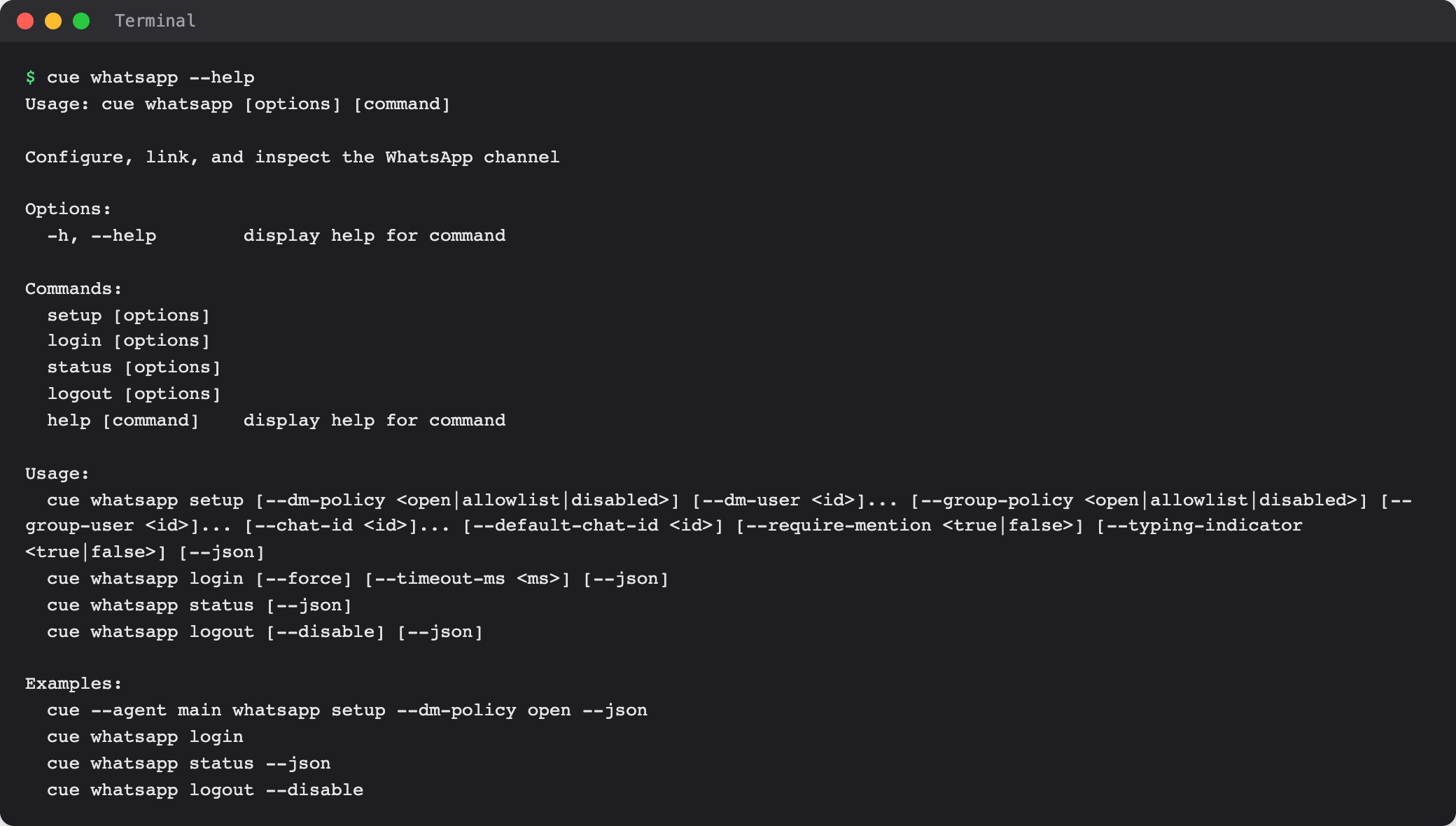
See the command reference for every option.
When Cue asks you first
The agent runs only for its owners. Anyone else gets the "Access denied" reply and the agent does not run. Because WhatsApp has no separate bot, that reply goes out from your own number.
Keep the default, which accepts direct messages only from your own number. If you run cue whatsapp setup --dm-policy open, anyone who messages your number gets an "Access denied" reply from you. Turning on groups with cue whatsapp setup --group-policy works the same way: Cue's messages in the group come from your number.
Remove an owner with cue --agent main channel owner remove --provider whatsapp <user-id>. Owner changes apply to the next message without a restart.
Limits today
- Everything Cue sends on WhatsApp comes from your own number. Messages you send to other people are not treated as requests to Cue.
- The link runs only while your computer is on and Cue CLI's background worker is running. If WhatsApp ends the link,
cue --agent main whatsapp status --jsonshows it is no longer linked; runcue --agent main whatsapp loginagain. - Replies include the model's reasoning text when the model returns any. To leave it out, run
cue config set agents.main.channels.whatsapp.includeThinking false --jsonand restart the worker. cue whatsapp logoutdoes not remove the device from your phone's Linked devices list; remove it there too.- Linking, a full message round trip, and unlinking were not walked end to end for this page. The steps follow Cue CLI's help and code.
Related
Extensions and integrations · Telegram · OpenClaw on WhatsApp · Cue CLI command reference